Which Inventory Management Software in Malaysia Best Optimises Stock Procurement?
Erra13 Aug 2026 06:43ENCopy link & title

Why Does Traditional Purchasing Fail Malaysian Marketplace Sellers?
Traditional purchasing methods fail online marketplace sellers because legacy procurement and supply chains rely on slow, manual workflows, rigid bulk minimums, and siloed data. As order volume grows, most sellers are still procuring stock the same way they did when they were a fraction of the size and that's where the delays start:
-
Slow replenishment cycles: Traditional buying requires long email chains, manual approvals, and physical paperwork, causing sellers to run out of stock during sudden sales spikes.
-
Inflexible minimum order quantities (MOQs): Traditional wholesalers demand massive bulk orders, tying up vital cash flow for small-to-midsize marketplace vendors who need lean inventory.
-
Delayed market response: Legacy forecasting tools use historical data rather than real-time marketplace analytics, making it hard to catch fast-moving consumer trends.
-
High operational overhead: Manual data entry and disconnected software systems increase administrative costs and lead to costly human errors.
-
Poor visibility into spending: Sellers cannot easily track "maverick" or off-contract spot purchases, leading to unexpected cost leakage that destroys thin profit margins.
-
Siloed supplier communication: Offline negotiations and fragmented vendor management prevent quick price comparisons or multi-supplier optimisation.
Over 70% of Malaysian SMEs still track inventory manually in some form, and that gap is estimated to cost businesses 15–20% of annual revenue through stockouts, overselling, and delayed purchasing decisions. Procurement doesn't slow down because sellers are careless, it slows down because nobody has one clear, current view of stock to buy against.
How Does Inventory Management Software Compare to Manual Procurement Methods?
Inventory management software automates stock tracking, reordering, and data entry in real time, reducing human error and saves time. Manual procurement relies on paper logs, spreadsheets, and human memory which cost less upfront, but lead to stockouts and high labor.
|
Procurement Task |
Manual Method |
BigSeller |
|
Checking stock before reordering |
Manually cross-check each platform and warehouse |
Real-time inventory ledger across all warehouses, instantly |
|
Deciding what to reorder |
Based on memory or gut feeling |
Smart purchase recommendations from live sales data |
|
Spotting slow-moving stock |
Rarely reviewed, discovered too late |
Auto-generated slow-mover reports via PSI analysis |
|
solving a shortage |
Always place a new purchase order |
Can transfer stock from another warehouse first |
|
Supplier/reseller order updates |
Confirmed manually by message or spreadsheet |
Real-time sync between supplier and reseller accounts |
|
Payment tracking with distribution partners |
Manual invoice chasing |
Automated billing with two-party reconciliation |
|
Tax and compliance records |
Reconciled separately, after the fact |
Direct integration with MyInvois and SQL Account (Malaysia) |
The pattern across every row is the same: manual procurement reacts to problems after they happen, while software-driven procurement flags them before stock actually runs out.
How Does BigSeller Optimise the Procurement Cycle for Marketplace Sellers in Malaysia?
BigSeller approaches procurement from three angles: keeping supplier and distribution relationships in sync, making the purchasing decision faster, and catching mistakes before an order is confirmed.
On the supplier and distribution side, BigSeller's Distribution module keeps both parties working from the same numbers:
-
Real-time inventory and order sync between supplier and reseller, so stock counts never fall out of date on either side
-
Per-customer-tier and per-product pricing, applied automatically instead of renegotiated on every order
-
Automated billing and after-sales handling, cutting out manual invoice chasing
-
Transparent two-party reconciliation, so both sides see the same numbers on what's owed and fulfilled
-
A one-click recruitment portal for onboarding new distribution partners
On the decision side, BigSeller's Inventory module removes the guesswork before a purchase order is even placed:
-
Smart purchase recommendations, generated from live stock levels across every connected warehouse
-
Purchase-Sales-Inventory (PSI) analysis, which auto-generates new/bestseller/slow-mover reports so sellers know exactly what to restock and what to stop ordering
-
Real-time inventory ledger per SKU, showing cost, bin location, and stock alert thresholds at all times
-
Stock-take management, so purchasing is based on confirmed physical counts, not outdated numbers
-
Inter-warehouse transfers, which can resolve a shortage without placing a new order at all, if stock already exists elsewhere in the network
On the control and accuracy side, BigSeller's Purchase module catches the mistakes that usually slip through when procurement moves fast:
-
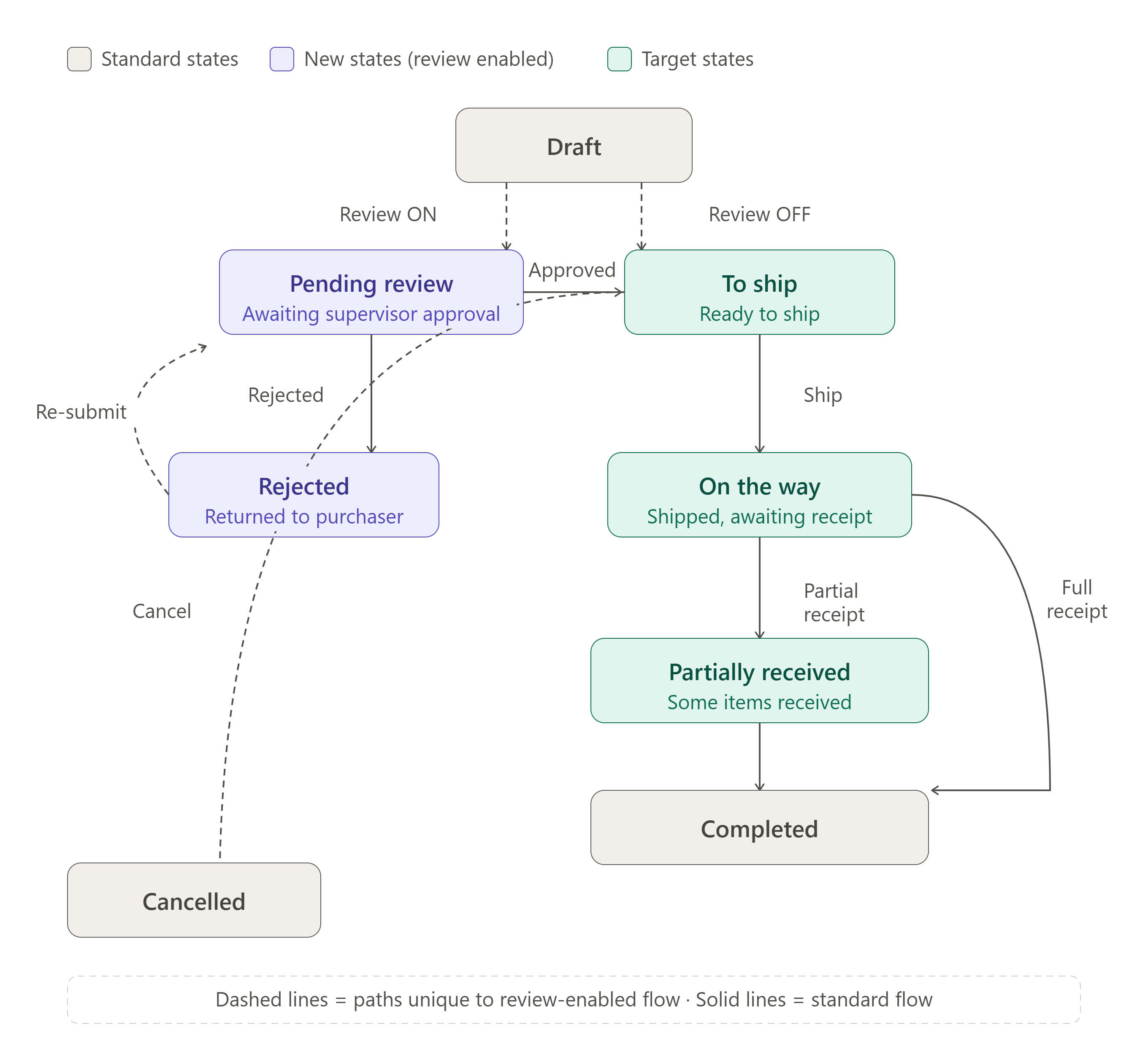
Purchase Order Review adds a supervisor approval step before an order ships, so a submitted order sits in Pending Review until quantities, unit prices, and other details are checked, catching over-purchasing or pricing errors before they become a confirmed order, not after
-
Rejected orders route back to the purchaser with the reviewer's notes attached, so corrections happen in one revision instead of a back-and-forth over chat
-
Purchase Order Change lets a purchaser update an order that's already in transit such as receiving warehouse, supplier, cost, quantity, and expiry date without cancelling and rebuilding it from scratch
-
Every change is tracked as its own record, capturing the before-and-after values, so the original purchase order and its cost history stay intact no matter how many adjustments happen along the way
-
Changes can require their own approval too, keeping a supervisor in the loop even when an order is modified mid-flight, not just at submission
Layered on top, BigSeller's Report module tracks receivables, flags overdue payments automatically, and auto-blocks orders when a distribution account balance runs low, so procurement stays connected to the financial side of the business, not just the stock side.