How a Smart POS System Prevents Inventory Errors Between Online and Offline Stores
Erra04 Mar 2026 03:59ENCopy link & title
For many sellers today, business no longer happens in just one place.
You might sell on Shopee or TikTok Shop during the day, reply to customers on WhatsApp at night, and still run a physical store where walk-in customers pay at the counter.
On paper, this sounds like growth.
In reality, many sellers quietly face the same problem:
Their offline and online businesses are running like two separate companies.
And over time, this separation creates operational issues that are easy to ignore, until they start affecting profits, inventory accuracy, and customer trust.
Let’s look at why syncing offline and online operations matters more than ever today.

The Hidden Cost of Running Offline and Online Separately
Most sellers don’t notice the problem immediately.
It doesn’t show up as a major crisis.
It shows up quietly, in small daily frustrations:
-
Stock looks available online but was already sold in-store
-
Staff record retail sales manually after closing hours
-
Refunds and exchanges become difficult to trace
-
Promotions differ between physical and digital stores
-
End-of-day reconciliation takes longer than it should
-
Financial numbers never fully match
None of these issues happen because you’re selling more.
They happen because your systems are disconnected.
Offline sales live in one place.
Online orders live somewhere else.
Inventory sits in multiple records.
And when data is fragmented, decisions are made using incomplete information.
At first, this only feels inconvenient.
Over time, it becomes operational friction:
-
You hesitate to run promotions because stock isn’t fully accurate.
-
You avoid expanding SKUs because tracking becomes messy.
-
You delay opening a second outlet because reporting is already complex.
The business grows, but the foundation stays fragile.
And fragile operations limit scale.

Modern Retail Isn’t “Online vs Offline” Anymore
Customers don’t think in channels.
They might:
-
Discover your product online
-
Visit your physical store to see it
-
Buy in-store
-
Request an exchange later through chat
To the customer, this is one smooth journey.
To many sellers, it becomes four separate processes handled by different systems.
That gap creates tension.
The customer expects continuity.
The seller operates in silos.
This is why more retailers are shifting toward unified commerce, where inventory, orders, promotions, payments, and after-sales are connected across both offline and online environments.
A POS system today is no longer just a cashier machine used to collect payment.
It becomes the operational bridge between channels.
Not to replace online stores.
Not to replace retail counters.
But to connect them.
What Happens When Offline Orders Sync With Your System
When offline retail orders are recorded inside the same ecosystem as your online operations, several changes happen immediately.
And most of them reduce stress before they increase revenue.
1. Inventory Becomes Shared, Not Separate
Instead of adjusting stock manually at night or updating spreadsheets after closing hours, offline sales automatically deduct inventory from the same warehouse used for online stores.
This prevents:
-
Overselling
-
Sudden stock-outs
-
Manual stock corrections
-
Late-night reconciliation
Each sale, whether it happens online or in-store updates the same data source.
There is no “retail stock” and “online stock.”
There is just stock.
That clarity alone reduces errors and improves planning.
2. Retail Orders Stop Being “Invisible Sales”
In traditional setups, walk-in transactions disappear after checkout unless someone manually records them later.
Over time, this creates blind spots:
-
You don’t know which SKUs perform best offline.
-
You can’t compare retail vs online margins clearly.
-
Promotions cannot be measured accurately.
When POS retail orders are integrated:
-
Offline transactions become structured orders.
-
Payment methods are automatically recorded.
-
Customer information can be captured.
-
Sales performance becomes measurable.
Offline revenue stops existing outside your system.
It becomes part of your overall business analytics.
And when every sale is visible, decision-making becomes data-driven instead of assumption-based.
So Where Does BigSeller Fit Into All This?
Most sellers already use tools to manage their online marketplaces.
They track:
-
Orders
-
Inventory
-
Shipping
-
Promotions
-
Performance data
The real challenge begins when offline sales remain outside that ecosystem.
That’s where the disconnect happens.
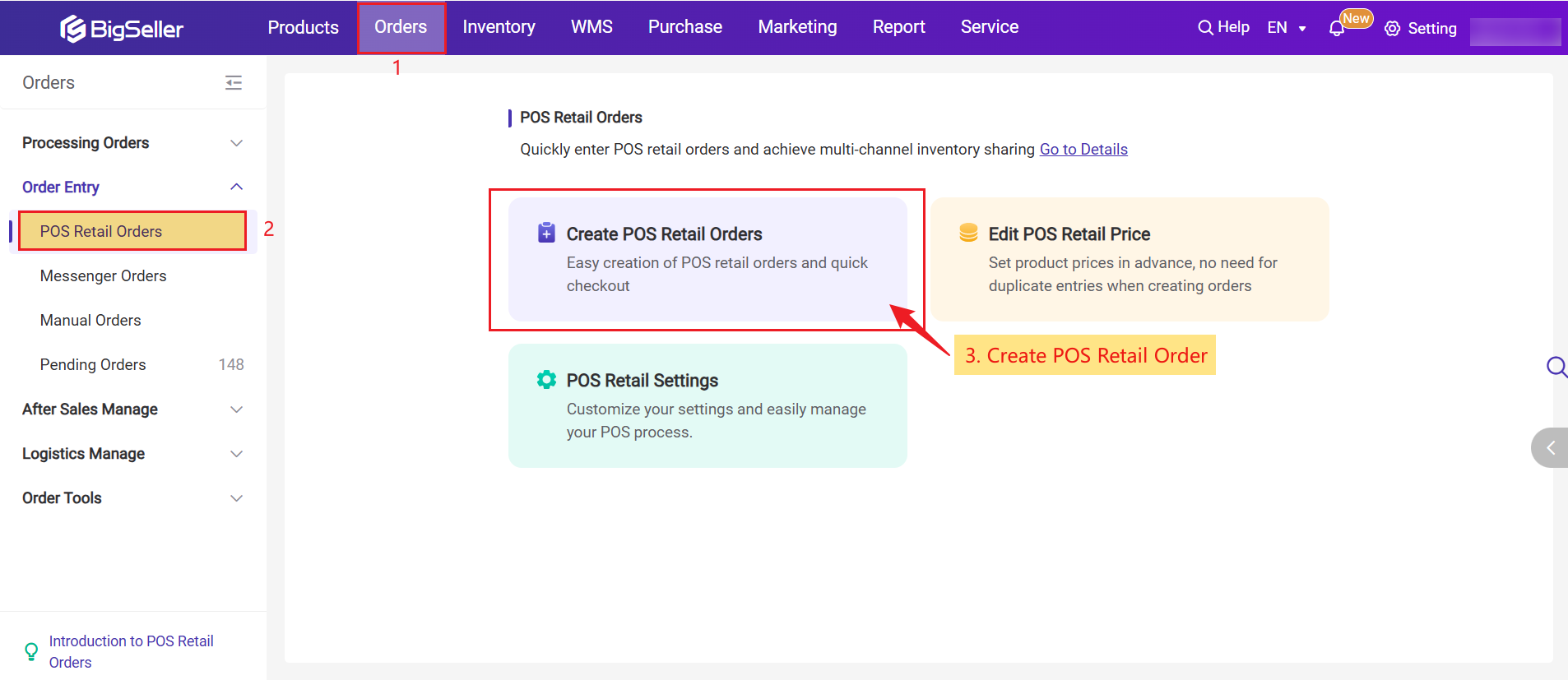
BigSeller POS system is designed to extend your existing order and inventory management into physical retail operations.
In simple terms:
Offline and online workflows operate within the same structure, instead of living in separate systems.
Rather than forcing sellers to change how they work, it connects the processes they already rely on:
-
POS retail orders
-
Real-time inventory syncing
-
Offline promotions
-
After-sales handling (returns, refunds, exchanges)
-
Financial reporting and business statements
-
Mobile retail operations via app
Everything flows inside one continuous process.
This means:
-
A walk-in sale updates the same stock used for online orders.
-
A retail refund adjusts inventory and financial records automatically.
-
Promotions can run in-store without manual calculations.
-
Daily reports reflect total business performance, not partial data.
BigSeller doesn’t replace your online management workflow.
It completes it.
And when offline and online stop competing and start syncing, operations become clearer, faster, and far more scalable.
The Real Goal Isn’t a POS System, It’s Operational Clarity
Sellers don’t wake up one day thinking, “I need a POS system.”
They wake up thinking:
-
“Why is my stock always off?”
-
“Why don’t my numbers match?”
-
“Why are refunds so messy?”
-
“Why does closing take so long every night?”
Offline and online don’t need to compete.
They need to communicate.
When your retail orders, promotions, after-sales, tax settings, and daily statements all run inside one connected workflow, something changes:
You stop reacting to problems.
You start running your business with clarity.
If you’re currently managing offline and online separately, maybe this is the moment to test what it feels like when everything syncs properly.
You can explore how the BigSeller POS system works inside your own operations, without commitment.
Try BigSeller for free today and claim a 7-day VIP trial coupon to test the full POS workflow, from order creation to after-sales and business statement closing.